


Commercial Real Estate LED Display Procurement Guide
Procuring commercial real estate LED displays is a major capital decision. Outdoor shopping malls require reliable displays that perform for years. For developers, procurement officers, and DOOH operators, an LED video wall serves two purposes. It enhances the building facade and generates advertising revenue. However, outdoor LED display projects can face serious operational risks. Poor waterproofing can cause premature LED failure and internal electrical damage.
Closed control systems can also create long-term software dependency. Corrosion, difficult maintenance, and expensive repairs can further increase lifecycle costs. The initial purchase price is therefore only one part of the investment. Procurement teams should evaluate performance, serviceability, integration, and total cost of ownership.
Before issuing an RFQ, buyers should focus on four critical engineering pillars. These factors help identify a truly commercial-grade outdoor video wall.
1. Four Mandatory Pillars for Commercial Outdoor Video Walls
Outdoor commercial displays face demanding operating conditions. Shopping malls also require stable operation and convenient maintenance.
A reliable commercial video wall should therefore meet four essential requirements:
-
IP66 ingress protection
-
Open SDK and API integration
-
Precision die-cast aluminum construction
-
Front and rear serviceability
These specifications affect reliability, installation, maintenance, and long-term operating costs.
2. Pillar 1: Choose True Outdoor Weatherproofing
Why IP66 Matters for Outdoor LED Displays
Many outdoor LED displays use an IP65 protection rating. IP65 protects against dust and water jets. However, commercial real estate applications can face more demanding conditions. Shopping mall facades may experience heavy rain, airborne dust, and high-pressure cleaning.
An IP66 outdoor LED display provides a higher level of enclosure protection. It offers a dust-tight design and stronger resistance to powerful water jets. This protection is especially important for large video walls. Water penetration can damage power supplies, receiving cards, modules, and internal connections.
When evaluating an RFQ, procurement teams should therefore verify the actual IP rating. They should also review sealing methods and environmental testing procedures.
What Buyers Should Check
Look for:
-
IP66-rated modules or cabinets
-
Sealed power connections
-
High-quality silicone gaskets
-
Weather-resistant cabinet construction
-
Waterproofing test procedures
-
Outdoor aging and environmental testing
A stated IP rating should always be supported by appropriate engineering documentation.
3. Pillar 2: Require Open SDK and API Integration
A commercial LED display is rarely operated as an independent screen. Shopping mall operators often manage multiple displays through centralized CMS platforms. A closed control system can create long-term software limitations. It may also make third-party integration more difficult. An open SDK/API control system provides greater flexibility for commercial applications. Operators can connect the display with existing CMS and media management platforms.
This can support functions such as:
-
Centralized content scheduling
-
Remote screen monitoring
-
Automated brightness adjustment
-
Diagnostic telemetry
-
Third-party media player integration
-
Network-based device management
For nationwide DOOH networks, software openness becomes even more important. Operators can manage multiple commercial video walls from a centralized platform. When comparing suppliers, procurement teams should ask for API documentation. They should also confirm SDK availability and third-party integration support.
4. Pillar 3: Evaluate Cabinet Material and Structural Integrity
Cabinet construction affects more than the appearance of an outdoor LED display. It also influences weight, thermal performance, corrosion resistance, and installation requirements. Traditional iron or sheet-metal cabinets can become vulnerable to corrosion. They can also add significant weight to large building facades.
Precision die-cast aluminum cabinets provide a different engineering approach. Aluminum combines structural strength with lower cabinet weight. The metal cabinet can also act as a passive heat dissipation structure. This helps transfer heat away from electronic components without relying entirely on active cooling.
For commercial real estate projects, buyers should evaluate:
-
Cabinet material
-
Structural weight
-
Corrosion resistance
-
Heat dissipation design
-
Mounting requirements
-
Long-term outdoor durability
Reducing cabinet weight can also simplify structural mounting. This becomes important when installing large LED displays on existing buildings.
5. Pillar 4: Prioritize Serviceability and Total Cost of Ownership
Maintenance is often overlooked during the initial procurement stage. However, service costs can become significant throughout an LED display’s lifecycle. Large video walls are often installed on retail facades. Difficult access can make simple component replacement expensive. A display with front and rear dual-serviceability provides greater maintenance flexibility. Technicians can access LED modules and internal components from the appropriate side.
Front-serviceable modules can simplify maintenance in restricted installation spaces. Technicians can replace modules, power supplies, or receiving cards without removing the entire cabinet. This can reduce repair time and help avoid expensive access equipment. It can also reduce potential advertising revenue losses caused by extended downtime.
When evaluating TCO, consider:
-
Module replacement time
-
Power supply accessibility
-
Receiving card accessibility
-
Front-service capability
-
Rear-service capability
-
Spare parts availability
-
Expected maintenance frequency
-
Labor and access equipment costs
The lowest purchase price does not always produce the lowest TCO.
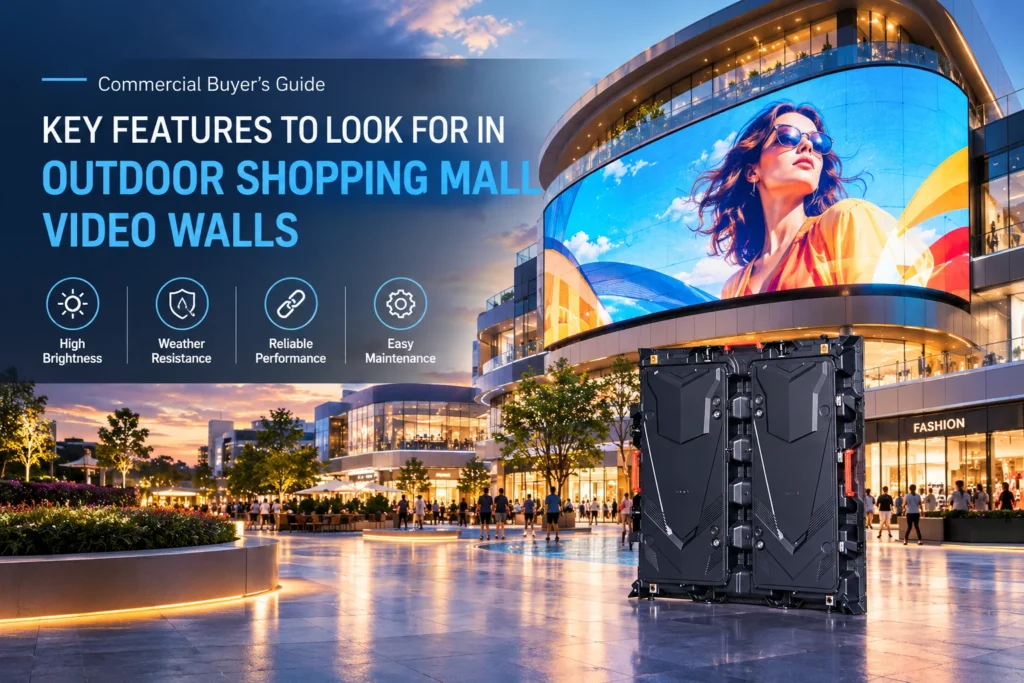
6. Commercial Video Wall Procurement Evaluation Matrix
A side-by-side comparison can help procurement teams identify important differences between suppliers.
| Technical Evaluation Criterion | Standard Outdoor Display | Commercial-Grade Solution: XOBLED YS4 | Commercial Impact |
|---|---|---|---|
| Ingress Protection | IP65 | IP66 fully sealed enclosure | Reduces water and dust exposure during severe weather |
| Cabinet Construction | Heavy sheet metal or iron alloy | Precision die-cast aluminum | Reduces structural load and improves corrosion resistance |
| Control System | Closed proprietary software | Open SDK/API support | Simplifies CMS and third-party integration |
| Maintenance Access | Rear service only | Front and rear dual serviceability | Reduces maintenance time and access costs |
| Thermal Management | Active fans | Passive aluminum heat dissipation | Reduces fan-related failures and energy consumption |
| Outdoor Application | General outdoor signage | Commercial real estate and DOOH | Supports demanding commercial installations |
This matrix gives procurement teams a practical framework for RFQ evaluation. It also helps separate basic outdoor displays from commercial-grade solutions.
7. Benchmark Example: XOBLED YS4 Commercial Outdoor LED Display
For outdoor shopping centers and flagship commercial properties, the XOBLED YS4 combines several procurement-focused features.
IP66 Outdoor Weather Protection
The YS4 uses sealed module housing and silicone-gasketed power connections. Its design provides IP66 waterproof and dust-proof protection.
This makes the display suitable for demanding outdoor commercial environments. It is designed to handle rain, dust, and other outdoor exposure.
Precision Die-Cast Aluminum Cabinet
The YS4 uses precision die-cast aluminum cabinet construction. This approach combines structural rigidity with a lightweight design.
The aluminum enclosure also supports passive heat dissipation. This can help reduce thermal stress during continuous outdoor operation.
Open SDK and API Architecture
The YS4 supports open SDK and API protocols for commercial display integration. This allows operators to connect the display with centralized management systems.
Operators can manage content schedules and monitor screen status remotely. Brightness control and diagnostic functions can also be integrated into commercial workflows.
Front and Rear Dual Maintenance
The YS4 supports both front and rear module access. This gives technicians greater flexibility during installation and maintenance.
Modules, receiving cards, and power supplies can be serviced more efficiently. Faster maintenance can help reduce display downtime and protect advertising revenue.
8. How to Evaluate Commercial Real Estate LED Display Suppliers
Choosing the right supplier requires more than comparing product prices. Procurement teams should evaluate the complete technical and service package.
Check Outdoor Protection
Confirm the actual IP rating and waterproofing design. Request relevant testing information when necessary.
Review Software Compatibility
Ask whether the control system supports open SDK and API protocols. Confirm compatibility with your existing CMS and media players.
Evaluate Structural Engineering
Review cabinet material, weight, mounting structure, and corrosion resistance. These factors directly affect facade installation.
Calculate Lifecycle Costs
Compare maintenance requirements instead of focusing only on purchase price. Include spare parts, labor, access equipment, energy consumption, and downtime.
Confirm Customization Capabilities
Large commercial projects rarely use completely standard configurations. Pixel pitch, cabinet dimensions, brightness, and mounting structures may require customization.
A capable supplier should support project-specific engineering requirements.
9. Commercial Applications for Outdoor LED Video Walls
Commercial real estate LED displays can support many high-visibility applications.
Common applications include:
-
Outdoor shopping malls
-
Flagship retail centers
-
Mixed-use developments
-
Commercial plazas
-
Building facades
-
DOOH advertising networks
-
Retail brand activations
-
Entertainment complexes
-
Transportation-oriented commercial spaces
For advertising-focused projects, display uptime is particularly important. Every hour of downtime can affect scheduled campaigns and advertising revenue.
This makes reliability and serviceability essential procurement considerations.
10. Custom Commercial LED Display Solutions from XOBLED
XOBLED develops custom outdoor LED displays for commercial real estate and DOOH applications.
The company supports project-specific requirements from initial engineering through production and delivery.
Custom Commercial Engineering
XOBLED can customize pixel pitch and cabinet dimensions. Curved display structures and high-brightness configurations are also available.
Engineering teams can develop solutions around specific architectural requirements. This helps integrate the LED video wall with the building facade.
Enterprise System Integration
XOBLED supports open control protocols for commercial display applications. Integration can include CMS platforms, environmental sensors, and remote diagnostic systems.
This helps operators manage large display networks more efficiently.
Complete B2B Project Support
Commercial projects may require more than hardware supply. XOBLED supports structural feasibility studies and CAD integration drawings.
The company can also assist with factory acceptance testing and international shipping. This provides a more complete procurement and deployment process.
11. Final Procurement Checklist
Before selecting a commercial real estate LED display, procurement teams should confirm the following:
-
Is the display rated IP66 for outdoor protection?
-
Does the cabinet use corrosion-resistant materials?
-
Is die-cast aluminum available for the project?
-
Does the control system support open SDK/API protocols?
-
Can the display integrate with the existing CMS?
-
Does the cabinet support front and rear maintenance?
-
Are spare parts readily available?
-
Can the supplier provide custom cabinet dimensions?
-
Can the supplier provide CAD integration support?
-
Has the total lifecycle cost been evaluated?
A structured checklist helps procurement teams compare suppliers more objectively. It also reduces the risk of selecting a display based only on initial purchase price.
Conclusion: Build Long-Term Value Into Your LED Display Investment
Selecting commercial real estate LED displays requires a long-term engineering perspective. Outdoor shopping malls need more than high brightness and attractive visual performance. IP66 protection helps address demanding outdoor conditions. Die-cast aluminum construction supports structural and thermal performance.
Open SDK/API integration provides greater software flexibility. Front and rear serviceability can also reduce long-term maintenance costs. Together, these four factors can improve operational reliability and lifecycle value. They can also help protect the advertising revenue generated by commercial video walls.
For commercial developers, DOOH operators, and retail brands, the right supplier should provide more than an LED screen. The ideal partner should provide a complete commercial display solution.
Partner with XOBLED for Custom Commercial Video Walls
XOBLED engineers custom commercial outdoor LED displays, shopping mall video walls, and digital signage solutions.
Solutions can be developed for real estate developers, commercial architects, DOOH operators, and global retail brands.
Protect your commercial display investment with a solution designed around your project requirements. Contact the XOBLED engineering team for product datasheets, CAD drawings, and custom project quotations.