


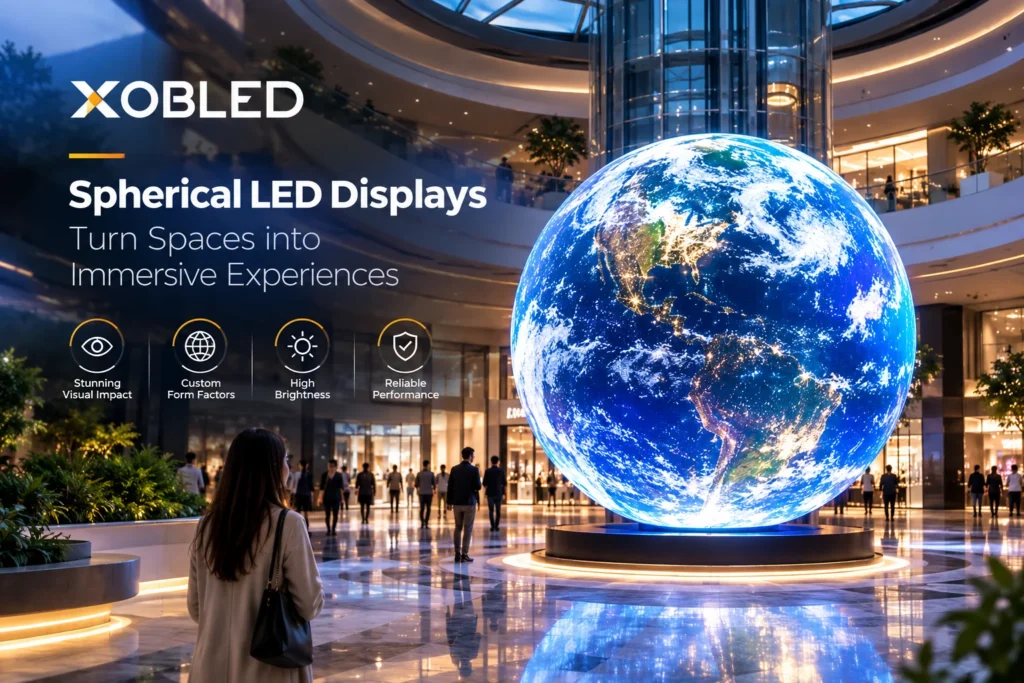
In crowded retail, cultural, and exhibition spaces, standard rectangular screens can easily become part of the background. Commercial developers, museum curators, and retail brand strategists increasingly need digital displays that do more than show content—they need to create a visual destination.
This is where an indoor spherical LED display offers a different approach. By combining a 360-degree viewing surface with an architectural form factor, a spherical LED screen can become a centerpiece within an atrium, museum, showroom, or exhibition environment.
Instead of treating the display as a conventional digital signage device, businesses can integrate the screen directly into the spatial experience. Its curved geometry supports immersive content, attracts attention from multiple directions, and creates opportunities for visitors to interact with and share the installation.
For high-end commercial environments, the premium cost of a custom spherical LED display therefore needs to be evaluated not only by screen specifications, but also by its potential contribution to visibility, visitor engagement, dwell time, and brand experience.
1. Why Spherical LED Displays Create More Visual Impact
The business value of a custom LED display begins with its ability to attract attention in a competitive physical environment.
A conventional flat LED screen has a defined front-facing viewing area. A spherical display changes that relationship by presenting content across a curved surface that can be viewed from multiple directions.
360-Degree Omnidirectional Visibility
A 360-degree ball display provides visual coverage around the entire spherical structure rather than concentrating content on a single viewing plane.
This makes it particularly useful in:
-
Shopping mall atriums
-
Museum halls
-
Exhibition centers
-
Brand experience stores
-
Trade show booths
-
Corporate showrooms
-
Public entertainment spaces
Visitors approaching the installation from different directions can encounter the same digital landmark without needing to stand directly in front of the screen.
Creating a Dwell-Time Opportunity
An unusual physical form can generate curiosity before visitors even understand the content being displayed.
For example, dynamic animations such as rotating planets, transforming faces, 3D product presentations, or immersive motion graphics can encourage visitors to stop and observe the screen.
For retailers and experience-driven venues, this creates an additional opportunity to connect physical foot traffic with digital content.
The actual effect on dwell time depends on factors such as content quality, placement, audience demographics, and venue traffic. However, the distinctive geometry gives content designers a physical platform that conventional rectangular signage cannot easily reproduce.
Becoming a Shareable Visual Landmark
Large spherical LED installations can also become part of the visual identity of a venue.
Visitors may photograph or record unusual digital installations for social media, particularly when the content is designed around recognizable visual effects or interactive experiences.
For shopping malls, exhibitions, flagship stores, and cultural venues, this can extend the reach of an installation beyond people physically present at the venue.

2. Where Indoor Spherical LED Displays Deliver the Most Value
A spherical LED screen is not necessary for every digital signage project. Its value is highest when the physical form itself contributes to the visitor experience.
2.1 High-End Retail Malls and Flagship Stores
Retail environments increasingly use digital media as part of interior architecture rather than simply installing screens on walls.
An indoor spherical LED display can be suspended in a central atrium, positioned above an island kiosk, or integrated into a flagship store’s experience zone.
Brands can use the display for:
-
Product launches
-
Brand storytelling
-
3D visual effects
-
Seasonal campaigns
-
Interactive animations
-
Ambient digital art
Because the screen does not rely on a conventional rectangular frame, it can function as both a media surface and an architectural focal point.
2.2 Museums, Planetariums, and Experience Centers
The spherical form has particular relevance to science and educational environments because many types of information are naturally represented on a globe.
Museums and experience centers can display:
-
Planetary systems
-
Earth and geographical data
-
Global weather information
-
Satellite visualization
-
Historical maps
-
Environmental data
-
Scientific simulations
Compared with a conventional flat display, the curved surface provides a more natural canvas for content involving the Earth, planets, atmospheric systems, or other spherical objects.
For planetariums and immersive science exhibitions, the display can therefore connect physical geometry with digital storytelling.
2.3 Experiential Trade Show Booths and Corporate Showrooms
Trade show floors are highly competitive visual environments. Multiple exhibitors may use large LED walls, transparent displays, and digital signage to attract visitors.
A giant spherical LED display provides a different visual anchor.
Instead of competing solely through screen size, exhibitors can use an unconventional form factor to communicate:
-
Technology capability
-
Product innovation
-
Corporate identity
-
Digital expertise
-
Engineering sophistication
The sphere can also serve as a central content platform around which product demonstrations, meeting areas, or interactive exhibits are organized.
3. How XOBLED Engineers Custom Spherical LED Displays
The visual effect of a spherical screen depends heavily on its underlying mechanical and LED architecture. A true spherical installation requires more than simply mounting conventional LED panels onto a curved structure.
XOBLED combines customized LED modules with precision structural design to create spherical display systems for commercial environments.
Seamless Modular Assembly
Spherical surfaces require LED modules with different geometries to maintain a continuous curve.
XOBLED can use customized trapezoidal and triangular flexible LED modules to follow the spherical structure and minimize visible gaps between sections.
This modular approach helps maintain:
-
Smooth spherical curvature
-
Consistent visual geometry
-
Controlled module alignment
-
Reduced visible seams
-
Flexible custom-diameter configurations
The exact module structure depends on the required sphere diameter, pixel pitch, viewing distance, and installation design.
High Refresh Rate for Camera-Friendly Content
Commercial LED displays are frequently recorded by smartphones, professional cameras, and broadcast equipment.
A high-refresh-rate LED system helps reduce visible flicker and scanning artifacts when the display is filmed.
This is particularly relevant for:
-
Trade shows
-
Retail marketing campaigns
-
Museum events
-
Social media content
-
Corporate presentations
-
Live demonstrations
For installations expected to generate significant video content, camera compatibility should be included in the display specification from the beginning.
Lightweight Construction and Flexible Installation
Indoor spherical displays may be installed in locations where structural load and mounting access must be carefully considered.
Depending on the project, a custom sphere can be designed for:
-
Floor-standing pedestal installation
-
Suspended ceiling installation
-
Central atrium installation
-
Exhibition booth installation
-
Custom architectural integration
The final mounting solution should be coordinated with the venue’s structural conditions, sphere diameter, total system weight, and maintenance requirements.
Modular Maintenance Access
A custom LED sphere also needs to be serviceable after installation.
Modular magnetic structures can provide front or internal maintenance access, depending on the system architecture. This allows technicians to replace individual LED modules or service internal components without necessarily dismantling the entire spherical structure.
For commercial venues, accessible maintenance can reduce service disruption and simplify long-term operation.
4. What B2B Buyers Should Evaluate Before Ordering
The price of a spherical LED display varies significantly because each project can involve a different diameter, pixel pitch, module structure, mounting method, and content requirement.
Before comparing supplier quotations, procurement teams should define the following parameters:
| Specification | Why It Matters |
|---|---|
| Sphere Diameter | Determines viewing distance, physical footprint, and LED quantity |
| Pixel Pitch | Influences image detail and recommended viewing distance |
| LED Module Geometry | Determines how smoothly modules form the spherical surface |
| Refresh Rate | Important for camera and video recording applications |
| Installation Method | Affects structural requirements and system design |
| Maintenance Access | Influences long-term service efficiency |
| Indoor Environment | Determines appropriate protection and component selection |
| Content Type | Helps determine resolution and visual performance requirements |
| Control System | Determines content playback and synchronization capabilities |
This specification-first approach helps buyers compare quotations based on the complete system rather than simply comparing the price per square meter.
5. Evaluating the ROI of a Spherical LED Display
The return on investment of a custom spherical LED display should not be measured solely through traditional advertising-screen metrics.
For high-end venues, the display may contribute value through several interconnected functions:
Visual Attraction
→ Creates a recognizable focal point
Visitor Engagement
→ Encourages people to stop and interact with content
Brand Experience
→ Connects digital media with physical architecture
Content Flexibility
→ Supports campaigns, events, product launches, and ambient visuals
Social Sharing
→ Creates opportunities for visitor-generated content
This makes spherical LED displays particularly relevant to projects where experience and architectural differentiation are part of the commercial objective.
However, the actual ROI depends on the venue, traffic volume, content strategy, installation cost, operating period, and business model. Buyers should therefore evaluate the complete project economics rather than assuming that a unique screen automatically produces a specific financial return.
6. Spherical LED Display vs. Conventional Flat LED Screen
The two formats serve different commercial objectives.
| Factor | Conventional Flat LED Display | Spherical LED Display |
|---|---|---|
| Viewing Direction | Primarily front-facing | Multi-directional |
| Physical Form | Rectangular | Spherical |
| Architectural Role | Digital signage | Signage + architectural centerpiece |
| Content Style | Standard video and graphics | Immersive, 360° and spherical content |
| Installation | Wall, frame, or structure | Suspended, pedestal, or custom structure |
| Best Fit | General digital signage | Premium experiential environments |
| Customization | Standard dimensions | Custom diameter and module geometry |
For projects where the primary objective is cost-effective information display, a conventional LED screen may be sufficient. For projects where visual differentiation, immersive content, and architectural integration are important, a custom spherical display provides another design option.
7. Why Custom Form Factor Matters in Premium Commercial Spaces
The increasing use of non-rectangular LED displays reflects a broader shift in commercial digital signage.
Businesses are no longer evaluating LED screens only by brightness, resolution, and square-meter pricing. In premium environments, the physical form of the display can become part of the customer experience.
A spherical screen can transform digital content into a three-dimensional architectural element. When combined with carefully designed content, strategic placement, and appropriate viewing conditions, the display can serve simultaneously as:
-
A digital signage platform
-
A visual landmark
-
An architectural feature
-
An interactive media surface
-
A brand experience tool
That combination is what makes custom form factors relevant to high-end retail, museums, experience centers, and corporate exhibition environments.
8. XOBLED Custom Indoor Spherical LED Display Solutions
XOBLED provides customized indoor spherical LED displays for commercial, cultural, retail, exhibition, and experiential applications.
From custom sphere diameters and pixel pitches to flexible LED modules and installation configurations, XOBLED works with B2B buyers to develop display systems around the requirements of the project.
Our engineering approach focuses on:
-
Custom spherical LED module design
-
Trapezoidal and triangular flexible LED modules
-
High-refresh-rate LED systems
-
Smooth 360-degree visual surfaces
-
Floor-standing and suspended installation options
-
Modular maintenance structures
-
Global B2B project support
For developers, museum teams, retail brands, exhibition contractors, and system integrators, the right spherical LED solution begins with understanding the venue, viewing distance, content, installation environment, and commercial objective.
Build a Custom Spherical LED Display for Your Project
An indoor spherical LED display can turn an ordinary digital signage installation into a distinctive architectural experience. Its value comes from the combination of 360-degree visibility, customized geometry, immersive content, and integration with the surrounding space.
If your project requires a custom sphere for a retail atrium, museum, planetarium, showroom, or exhibition booth, contact XOBLED to discuss custom diameter configurations, pixel pitch options, LED module design, mounting solutions, and B2B supply requirements.