


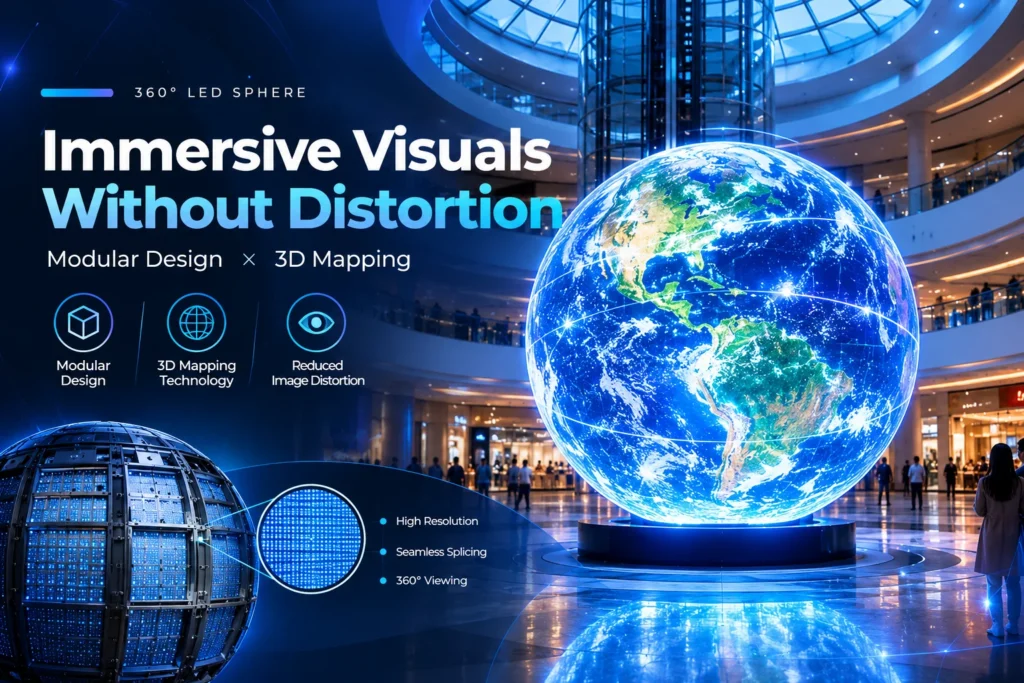
A 360-degree LED sphere creates immersive visual experiences by displaying dynamic content across a curved, multidirectional surface. Sin embargo, building a spherical LED display presents challenges that flat LED walls do not face. Engineers must manage curved geometry, module alignment, pixel distribution, and content distortion to achieve a consistent viewing experience.
For AV integrators, display manufacturers, and project buyers, image quality depends on two key factors: precision-engineered LED modules and properly calibrated 3D mapping software. Custom triangular and trapezoidal modules help form the spherical structure, while mapping and calibration align digital content with the display’s physical geometry.
Understanding how these systems work together helps buyers evaluate spherical LED displays, compare technical specifications, and plan immersive installations more effectively.
1. Why Does a 360-Degree LED Sphere Require Special Engineering?
A conventional LED video wall uses a flat or gently curved arrangement of rectangular cabinets. A spherical LED display must follow curvature in multiple directions, which makes mechanical alignment and content mapping more complex.
Using standard rectangular modules without an appropriate structural design can create uneven edges, visible gaps, inconsistent surface alignment, or inefficient use of the spherical surface.
Engineers must address three primary challenges.
1.1 Spherical Surface Geometry
A sphere curves both horizontally and vertically. Por lo tanto, its LED modules must follow the intended surface geometry while maintaining consistent alignment between adjacent sections.
Custom triangular and trapezoidal modules can help approximate the spherical surface through carefully designed panel arrangements. Their shapes allow engineers to distribute modules across different regions of the sphere while managing the transitions between sections.
Sin embargo, the module shape alone does not guarantee a seamless result. Frame accuracy, mounting tolerances, cabinet design, and installation calibration also affect the final surface.
1.2 Pixel Distribution Across the Sphere
A spherical display presents content from different directions, and the physical arrangement of its pixels influences how images appear across the surface.
The relationship between pixel pitch, module geometry, distancia de visión, and the sphere’s dimensions determines the display’s effective resolution and perceived image sharpness.
Engineers should evaluate the pixel layout across the entire sphere, including regions near the poles and the equator. A carefully planned layout helps maintain consistent visual quality without assuming that every region will have identical pixel spacing or perceived sharpness.
1.3 Content Distortion on a Curved Display
Standard video content usually uses a rectangular aspect ratio, como 16:9. A spherical display, however, has a three-dimensional surface.
Displaying rectangular content directly without appropriate mapping can stretch, compress, or reposition visual elements. Circular objects may appear elliptical, text may become difficult to read, and straight lines may curve unexpectedly.
To address these issues, engineers must match the content mapping method to the display geometry and the intended viewing experience.
2. Triangular vs. Rectangular LED Modules for Spherical Displays
The choice of LED module design affects how efficiently a display can follow spherical curvature. Buyers should evaluate module geometry alongside pixel pitch, structural tolerances, maintenance access, and the manufacturer’s assembly method.
| Engineering factor | Standard rectangular modules | Custom triangular or trapezoidal modules |
|---|---|---|
| Surface geometry | May require a specialized frame or segmented arrangement to approximate a sphere | Can support more flexible arrangements across curved surface sections |
| Module alignment | Requires careful management of cabinet edges and joints | Requires accurate alignment of shaped modules and their mounting structure |
| Surface gaps | Gaps may occur if the cabinet layout does not match the intended geometry | A geometry-specific layout can help reduce visible gaps |
| Pixel distribution | Depends on cabinet arrangement and pixel layout | Can be engineered for the intended spherical pixel layout |
| Thermal management | Depends on the cabinet, LED modules, and cooling design | Can incorporate cooling solutions suited to the module and enclosure design |
| Mantenimiento | Depends on the product’s service architecture | May support individual-section replacement if the display is designed for modular service |
Key takeaway: Custom module geometry helps establish the physical shape of a 360-degree LED sphere. It does not independently eliminate image distortion, costuras visibles, or differences in pixel density. These outcomes also depend on mechanical precision, LED placement, calibration, and content processing.
3. How 3D Mapping Software Reduces Distortion on a 360-Degree LED Sphere
Physical engineering determines the shape of the display, but software determines how digital content fits that shape.
A 3D mapping workflow uses information about the display’s geometry to transform incoming content into a format suitable for the spherical surface. Depending on the system, this process may involve UV mapping, geometric warping, coordinate transformations, and calibration.
A simplified workflow looks like this:
Rectangular video source → Spherical geometry mapping → Geometric correction and calibration → LED controller → Spherical display
The exact workflow varies by media server, controller, and display architecture.
3.1 UV Mapping and Coordinate Transformation
UV mapping establishes a relationship between points on a three-dimensional surface and coordinates in a two-dimensional image.
For a spherical LED display, this mapping helps the system determine where each part of the source content should appear on the physical screen.
The processing system can transform the source image to compensate for the display’s geometry. Como resultado, content can appear more proportionate from the intended viewing position or viewing region.
Por ejemplo, an advertisement containing a logo, product image, and text needs appropriate mapping so that important elements remain recognizable across the curved surface.
The mapping method should match the display’s actual geometry. Engineers should therefore confirm the required content format, mapping template, and calibration workflow before production begins.
3.2 Managing Distortion Near the Poles
The upper and lower regions of a spherical display can present particular mapping challenges. Depending on the projection method, content may become compressed, stretched, or distributed unevenly near the poles.
Geometric correction can compensate for these effects by adjusting the relationship between source-image coordinates and display coordinates.
Sin embargo, software cannot change the physical pixel count or remove every limitation of the display geometry. The achievable image quality depends on pixel pitch, module arrangement, viewing angle, source resolution, and the selected mapping method.
Por esta razón, project teams should test representative content across the sphere rather than evaluate image quality from a single front-facing view.
3.3 Controller Synchronization and Image Consistency
A spherical LED display may use multiple LED modules, receiving cards, and control channels. The system must coordinate these components to maintain consistent image playback across the surface.
Relevant parameters include:
-
Refresh rate: Affects how the display updates images and may influence flicker performance under certain viewing and camera conditions.
-
Grayscale performance: Influences tonal transitions and the reproduction of darker content.
-
Color calibration: Helps maintain consistent color appearance across different modules.
-
Geometric calibration: Aligns displayed content with the physical LED surface.
-
Signal and playback synchronization: Helps prevent timing differences between display sections.
A high refresh rate, como 3840 Hz, may be a useful specification for some applications, but it does not by itself guarantee seamless imagery. Buyers should evaluate refresh rate alongside grayscale performance, controller compatibility, calibration, and the intended camera or viewing conditions.
For large installations, the project team should also confirm whether the system uses a single controller, multiple synchronized controllers, or a media server with dedicated mapping functions.
4. Hardware and Software Must Work Together
A successful 360-degree LED sphere requires coordination between its mechanical structure, LED modules, control system, and content workflow.
| System component | Primary function | What buyers should verify |
|---|---|---|
| Spherical frame | Supports the overall display geometry | Structural stability, método de instalación, and project-specific load requirements |
| Custom LED modules | Form the spherical surface | Module geometry, paso de píxel, alignment, and replacement method |
| LED control system | Processes and distributes display signals | Resolution capacity, frecuencia de actualización, grayscale, and system compatibility |
| 3D mapping software | Transforms content to fit the display geometry | Supported mapping formats, calibration tools, and workflow requirements |
| Color calibration | Helps match color and brightness between display sections | Calibration method and uniformity across the surface |
| Thermal management | Controls heat generated by the display system | Heat dissipation design, operating conditions, y requisitos de mantenimiento |
| Service architecture | Supports inspection and component replacement | Front or rear access, replacement procedures, and spare-part availability |
A well-designed system treats these elements as a coordinated solution rather than relying on module shape or software correction alone.
5. Maintenance Considerations for 360-Degree LED Spheres
Maintenance access affects installation planning, operating costs, and service downtime. Buyers should confirm how technicians can reach individual LED modules and internal electronic components before finalizing the display design.
Some spherical LED displays use magnetic front-service modules and specialized suction tools. Where this design is available, technicians may be able to remove selected modules without dismantling the entire spherical structure.
Sin embargo, front access is not universal. Other products may require rear access, partial structural disassembly, or a specific maintenance platform.
Before purchasing, confirm:
-
Whether the LED modules support front maintenance, rear maintenance, or both.
-
Which tools technicians need to remove and reinstall modules.
-
Whether technicians can replace receiving cards and LED boards independently.
-
How the design supports cable access and internal component inspection.
-
Whether spare modules and replacement components will remain available.
-
What maintenance clearances the installation site must provide.
These details are particularly important for displays installed in shopping malls, entertainment venues, exhibition spaces, and other locations where prolonged downtime may disrupt commercial activities.
6. B2B FAQs About 360-Degree LED Spheres
Q1: Why can’t standard flat LED panels simply be assembled into a sphere?
Standard rectangular panels do not automatically match the compound curvature of a sphere. A specialized frame and carefully planned module arrangement may be needed, while custom triangular or trapezoidal modules can provide more flexibility for spherical layouts. The appropriate solution depends on the display geometry, paso de píxel, and structural design.
Q2: Does a 360-degree LED sphere require specially produced video content?
Not always. Standard rectangular video content may work if the controller or media server supports the required mapping. Sin embargo, some content may need cropping, warping, or reformatting to look correct across the spherical surface.
For best results, content creators should work with the display supplier to get the right mapping template and safe-area guidelines before producing final assets.
Q3: Can 3D mapping eliminate image distortion?
No mapping method can guarantee distortion-free results under every viewing condition. Geometric correction can substantially improve the alignment between source content and display geometry, but the final appearance also depends on physical pixel placement, module alignment, viewing position, and content design.
Q4: Does a higher refresh rate guarantee better spherical image quality?
No. Refresh rate is only one performance parameter. Buyers should also evaluate grayscale performance, color consistency, paso de píxel, controller capabilities, and geometric calibration. Camera-based applications may require additional testing under the intended recording conditions.
Q5: How do technicians replace LED modules on a spherical display?
The procedure depends on the product’s service architecture. Some models support front removal using magnetic modules and dedicated suction tools, while others require rear access. Buyers should confirm the actual maintenance method, required tools, and replacement procedures with the manufacturer.
Q6: What should buyers include in an RFQ for a spherical LED display?
An effective request for quotation should specify the sphere diameter, paso de píxel, intended viewing distance, entorno de instalación, brightness requirements, control system, content mapping needs, maintenance access, and project-specific structural requirements.
Buyers should also request information about power consumption, thermal management, calibration procedures, warranty coverage, and available technical support.
7. Plan Your 360-Degree LED Sphere Project with the Right Engineering Partner
A high-quality 360-degree LED sphere depends on more than a curved LED surface. Custom module geometry helps the hardware follow the spherical structure, while 3D mapping and calibration help content appear correctly across the display.
For AV integrators, commercial display buyers, and immersive venue developers, evaluating these elements together can help reduce installation issues and improve long-term serviceability.
Before selecting a solution, review the display’s mechanical design, pixel layout, mapping workflow, control-system capabilities, and maintenance requirements with an experienced LED display engineering team.
Contact a specialist LED display manufacturer to discuss your sphere dimensions, paso de píxel, entorno de instalación, and content requirements. A project-specific assessment can help determine the most suitable module configuration and mapping approach for your application.