


Contrairement à l'affichage numérique plat, un cylindrical LED display offers a seamless 360-degree viewing experience, transformer les colonnes structurelles en centres médiatiques à fort impact. Cependant, Choisir le bon écran LED cylindrique implique des paramètres techniques très différents en fonction de l'environnement physique, distance de visualisation, formats de contenu, et contraintes structurelles.
Rationaliser les achats pour les opérateurs commerciaux, chefs de marque, and outdoor advertising vendors, this guide presents a structured Scene → Dimensions → Content Type → Control Method framework across four primary commercial applications.
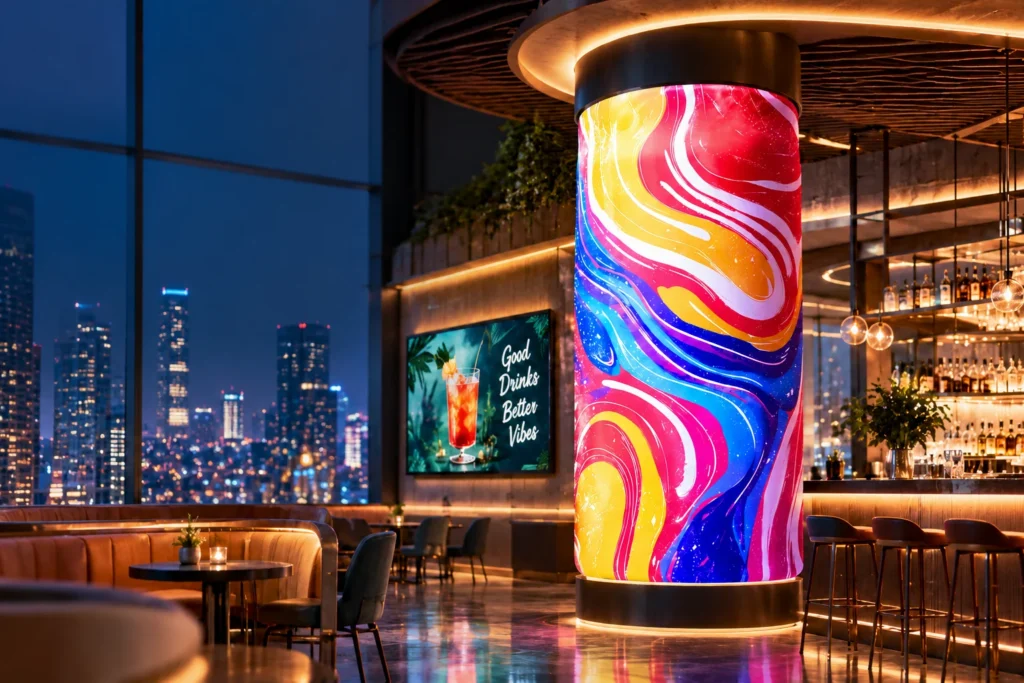
The 4-Scene Selection Framework
1. Barres & Nightclubs: Compact Atmosphere Builders
In nightlife environments, cylinder LED displays are typically integrated directly into central bar counters or DJ booths to boost visual energy and brand engagement.
-
Recommended Dimensions: Small diameter (30 cm – 50 cm), moderate height (1.5 m- 2.0 m).
-
Pixel Pitch Recommendation: P1.5 to P2.5 (due to close viewing distance of 1–3 meters).
-
Content Type: Dynamic audio-reactive visuals, motion graphics, brand identity loops, and ambient lighting effects.
-
Méthode de contrôle: Real-time audio sync via DMX or MIDI integration with light controllers and DJ soundboards.
2. Beverage Shops & Retail Islands: Product-Shaped Promo Hubs
In high-foot-traffic retail spaces—such as bubble tea shops, cafes, or cosmetic island counters—displays are often customized to resemble beverage cans, bottles, or product packaging.
-
Recommended Dimensions: Compact diameter (40 cm – 60 cm), height matched to product proportions.
-
Pixel Pitch Recommendation: P1.8 to P2.0 for crisp product detail at eye level.
-
Content Type: High-definition product displays, promotional offers, dynamic menu rotations, and seasonal branding visuals.
-
Méthode de contrôle: Cloud-based remote publishing for automated menu schedules and multi-store content management.
3. Exhibition Booths & Trade Shows: High-Impact Modular Features
Exhibition venues require eye-catching display columns that deliver dynamic messaging while maintaining portability and fast assembly.
-
Recommended Dimensions: Medium to large diameter (60 cm – 100 cm), height ranging from 2.0 m to 3.0 m.
-
Pixel Pitch Recommendation: P2.0 to P2.5 for balanced clarity and screen size efficiency.
-
Content Type: High-resolution brand showreels, interactive customer demos, and live presentation feeds.
-
Méthode de contrôle: Multi-signal input processors supporting live HDMI/SDI switching, wireless screen mirroring, and local media playback.
4. Commercial Atriums & Malls: Architectural Landmark Screens
Multi-story shopping mall atriums utilize structural support columns as large-format advertising inventory visible across multiple floors.
-
Recommended Dimensions: Large diameter (1.0 m to 3.0+ m), height spanning 3.0 m to 10.0+ m.
-
Pixel Pitch Recommendation: P2.5 to P4.0 (distance de visualisation > 5 mètres).
-
Content Type: High-definition 3D video loops, multi-brand advertising carousels, and emergency event announcements.
-
Méthode de contrôle: Enterprise-grade cloud CMS with multi-zone split-screen playback, scheduled playlist publishing, and automated display monitoring.
4-Scene Technical Comparison Framework
| Scenario | Diamètre | Height | Recommended Pixel Pitch | Core Content Type | Primary Control Method |
| Bar / Nightclub | 30 cm – 50 cm | 1.5 m- 2.0 m | P1.5 – P2.0 | Audio-reactive visuals, motion loops | Real-time audio-visual sync (DMX/MIDI) |
| Beverage / Vente au détail | 40 cm – 60 cm | 1.0 m- 1.8 m | P1.8 – P2.0 | Product promos, menu carousels | CMS cloud / Remote updates |
| Exhibition Booth | 60 cm – 100 cm | 2.0 m- 3.0 m | P2.0 – P2.5 | Brand showreels, live video feeds | Multi-signal video processor / HDMI switch |
| Commercial Atrium | 1.0 m- 3.0 m+ | 3.0 m- 10.0 m+ | P2.5 – P4.0 | 3D anamorphic ads, split-screen media | Enterprise Cloud CMS & split-screen controller |
Frequently Asked Questions (FAQ)
Q: What diameter is ideal for a bar counter cylinder LED display?
UN: A diameter between 30 cm and 50 cm works best for most bar counter installations. This compact size preserves counter workspace while creating an immersive focal point at eye level. For smaller diameter cylinders, flexible LED modules with a high refresh rate ($\ge 3840\text{ Hz}$) are required to avoid visual distortions or flickering.
Q: Are mobile or rental cylinder LED displays practical for trade show exhibitions?
UN: Oui. Rental-grade cylinder LED displays utilize modular flexible LED cabinets with quick-lock mechanisms and custom flight cases. These systems allow quick assembly and disassembly without specialized structural fabrication, making them highly portable across trade show circuits.
Q: How is the weight and structural load calculated for large atrium cylinder displays?
UN: Structural calculations must account for three core factors:
-
Screen Cabinet Weight: Typically 18 kg to 28 kg per square meter for indoor flexible module structures.
-
Internal Steel Framework: Internal support structures add an additional 15 kg to 25 kg per square meter.
-
Safety Coefficient: Structural engineers apply a safety factor (typiquement $1.5\times$ à $2.0\times$ total static weight) to accommodate dynamic wind loads, maintenance rigging, and building vibration. Always verify floor load-bearing capacity with facility managers before installation.
Résumé & Next Steps
Selecting the right cylinder LED display requires matching physical dimensions, pixel density, and control software to the unique demands of your commercial venue:
-
Barres prioritize compact, high-refresh displays with audio-visual synchronization.
-
Retail spaces rely on product-shaped columns with remote cloud management.
-
Expositions require portable, multi-input screens for dynamic content switching.
-
Shopping mall atriums demand structural engineering precision, large-format pixel tuning, and enterprise CMS capabilities.
By defining your requirements through the Scene → Dimensions → Content Type → Control Method cadre, you ensure optimal visual impact, reliable operation, and maximum return on investment.